
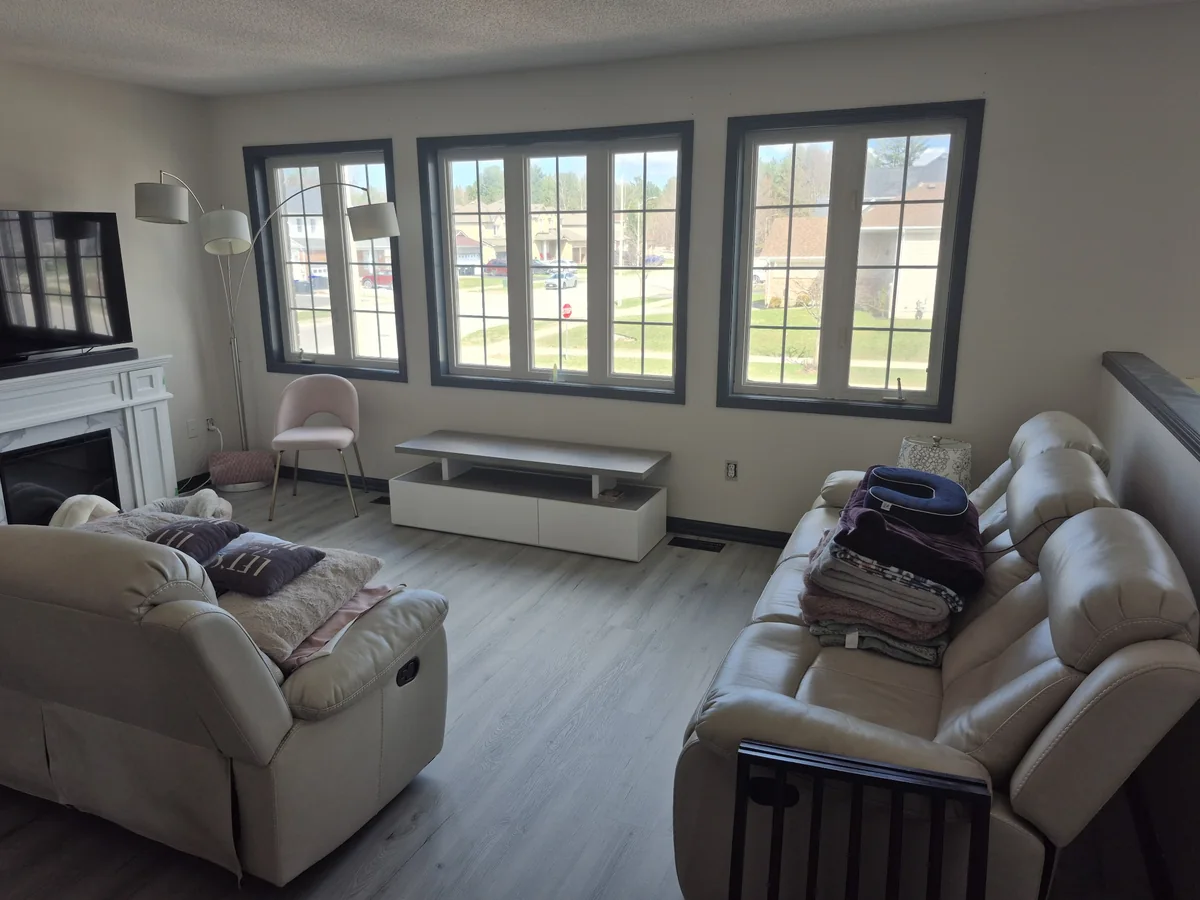
For most Barrie homes, vinyl plank holds up better anywhere water is part of daily life: basements, kitchens, bathrooms and the front entry where snow and slush come in on boots all winter. Laminate holds its own in dry rooms like bedrooms, living rooms and upstairs hallways, where its hard surface and wood look do the job well. So which one's better comes down to which rooms you're doing and what those rooms go through.
This guide compares the two side by side, gives a clear verdict for basements, pets, rentals and resale, and explains how pricing works when Hunt Contracting installs either one.
Not sure which fits your rooms? Tell Rob which rooms you're doing and whether pets, a basement or a rental unit are involved. He'll give you a free, no-obligation written estimate, usually within about 24 hours. Request an estimate.
Vinyl plank vs laminate at a glance
| Vinyl plank | Laminate | |
|---|---|---|
| Core | Plastic-based (PVC) core | Wood-fibre core under a printed photo layer |
| Water | Handles spills, wet boots and damp areas well | Surface resists spills; the core can swell if water sits or gets into the seams |
| Scratches | Good; the wear layer varies by product | Very good; hard top layer stands up to daily wear |
| Dents | Softer, so heavy furniture can leave marks | Harder surface resists dents, but edges can chip |
| Feel and sound | Softer and quieter underfoot | Firmer; can sound more hollow |
| Basements | Usually the safer pick | Riskier below grade |
| Underlay | Most products come with it attached | Most products come with it attached |
| Typical Barrie installation range | $2.00 to $5.00 per square foot labour-only; roughly $4.00 to $9.50 per square foot supply-and-install | $2.00 to $5.00 per square foot labour-only; roughly $4.00 to $9.50 per square foot supply-and-install |
| Typical install time | About 2 days for a typical job | About 2 days for a typical job |
The last two rows matter. Rob installs both floors at the same rate, so your choice can come down to what suits the room rather than which one costs less to put in.
What actually makes them different
Both floors are click-together planks designed to look like hardwood, and both install as a "floating" floor rather than being nailed or glued down. The difference is what's inside.
Laminate is built on a dense wood-fibre board with a printed image and a clear, hard wear layer on top. That top layer is why laminate resists scratches so well. The weak point is the core: wood fibre and standing water don't mix. A wiped-up spill is fine, but water that sits, or seeps into the joints, can make the edges swell and lift.
Vinyl plank uses a plastic-based core. Water doesn't break it down the way it does wood fibre, which is why it's the go-to in rooms that see moisture. It's also a little softer and quieter to walk on, though that softness means heavy furniture legs can leave impressions.
Which one lasts longer?
Neither floor wins on lifespan across the board. How long either one lasts depends mostly on the product quality and the room it goes in:
- Vinyl plank: look at the wear layer. As a general rule, a thicker wear layer stands up better to scratches and scuffs over time.
- Laminate: look at the abrasion (AC) rating on the box. Higher ratings are made for heavier traffic.
- The room: laminate in a dry bedroom can outlast vinyl plank in the same space, but laminate in a wet entry or basement often fails early from swelling at the seams.
Put the right floor in the right room, and both can serve you well for years.
Moisture: the deciding factor in most Barrie homes
Barrie winters put floors through a lot. Snow and salty slush get tracked into front halls and mudrooms for months. Kitchens and bathrooms see spills and splashes year-round. And many homes in the area, older and newer alike, have basements where the concrete below can feel cool and damp.
That's where vinyl plank earns its keep. In any room where water is a regular visitor, it's the lower-risk choice.
Basements deserve a quick note on their own. Vinyl plank is usually the safer pick below grade, but the condition of the space matters as much as the flooring. If there's an active leak or a recurring water problem, that needs to be dealt with before any new floor goes down. We cover this in more depth in Choosing Basement Flooring in Barrie.
For dry, above-grade rooms, laminate is a perfectly good choice and many people prefer its firmer feel.
Pets: scratches vs accidents
- Claws: Laminate's hard wear layer handles scratching well. Vinyl plank holds up too, but how well depends on the product's wear layer.
- Accidents and water bowls: Vinyl plank has the edge. A mess that isn't found right away is much less of a concern on a plastic core than on wood fibre.
- Noise: Vinyl plank is quieter, so you hear less clicking when dogs move around.
If your pets are mostly in dry living areas and accidents are rare, laminate works. If you have a puppy, an older dog, or water bowls in the kitchen, vinyl plank is the safer bet.
Rentals: durability between tenants
For rental and property owners, the priority is a floor that survives turnover without a costly redo. Laminate gives a durable, scratch-resistant surface for bedrooms and living areas, and we've written about that in Laminate Flooring for Rental Properties. Vinyl plank is the better pick for rental kitchens, bathrooms, entries and basement units, where you can't control how quickly a spill gets cleaned up.
Many landlords use both: laminate in the dry rooms, vinyl plank anywhere water could sit. Hunt works with rental and property owners, and Rob can price the whole unit in one written estimate.
Resale: what buyers notice
Buyers walking through a listing mostly notice whether the floors look clean, current and consistent, not which material they are. Choose the floor that suits each room and focus on a clean, finished install. Turnaround matters too, and a typical install takes Hunt about 2 days.
"I was in a situation in which I needed quality flooring done quickly as I had a condo listed that needed updating. Rob did a fantastic job of installing the new flooring, and it looked great. A very professional job done with a tight deadline. Highly, highly recommended!" (Holly Manning, Facebook recommendation)
For more on timing and choices before a sale, see Updating Floors Before You List.
The verdict: which one is best for what
- Best for basements: Vinyl plank. It's the lower-risk choice below grade.
- Best for kitchens, bathrooms and entries: Vinyl plank, for spills, splashes and winter slush.
- Best for pets: Vinyl plank for accidents and water bowls; laminate if scratching is the main concern in dry rooms.
- Best for rentals: Vinyl plank in wet areas and basement units; laminate in dry bedrooms and living rooms.
- Best for resale: Whichever suits each room, installed cleanly and consistently.
- Best for dry bedrooms and living rooms: Either works. Laminate gives a firm, hard-wearing surface; vinyl plank is softer and quieter.
Mixing both floors in one house? That's common, and Rob can price every room in one written estimate. Send him your room list and he'll come back with a free, no-obligation quote, usually within about 24 hours. Booking early helps get your project on the schedule sooner. Request your estimate or call 705-716-7069.
Installation cost: similar ranges for both
Because laminate and vinyl plank can be priced differently depending on product and prep, a range is more useful than a single rate. In Barrie, labour-only installation commonly falls around $2.00 to $5.00 per square foot, while supply-and-install pricing can run roughly $4.00 to $9.50 per square foot.
Removing and disposing of old flooring is extra where required, and it's itemized on your written estimate. Baseboard and shoe moulding can vary roughly from $2 to $5 per linear foot installed, depending on profile, material and finishing. Transitions where the new floor meets carpet or tile are included, and Rob aims for seamless runs wherever possible. Subfloor levelling is not usually needed; if it is, it's priced after Rob sees it.
Your written estimate confirms the final figure. For a fuller breakdown, see what affects flooring installation cost in Barrie.
How Rob helps you choose
Tell Rob which rooms you're doing, roughly how big they are and what's there now. When it helps, he looks at the rooms in person and talks through which spaces suit vinyl plank and where laminate makes sense. You then get a written price, with Hunt supplying the flooring or you bringing your own. The install comes with progress updates and a final cleanup.
Rob has 10 years of industry experience, and Hunt carries general liability insurance and WSIB coverage. Payment is a 50% deposit up front, with the rest on completion. More detail is on our flooring installation page.
Get a clear answer for your rooms
If you're still torn between vinyl plank and laminate, the quickest way to settle it is to have Rob look at the rooms and what they go through. Estimates are free, written and no obligation. Rob usually responds within about 24 hours, and booking early helps get your project on the schedule sooner.
Call 705-716-7069, email quotes@huntcontracting.ca, or request your free estimate online.
Common questions
Frequently Asked Questions
Is vinyl plank or laminate better for a basement?
Vinyl plank is usually the safer choice for a basement. Its plastic-based core isn't damaged by moisture the way laminate's wood-fibre core can be. Any active leak or recurring water problem should be fixed first. Rob can look at your basement and recommend the right floor in a free written estimate.
Is laminate or vinyl plank better with dogs?
Laminate's hard top layer resists claw scratches well, which suits dry living areas. Vinyl plank handles accidents and spilled water bowls better and is quieter underfoot. For puppies, older dogs or kitchens, vinyl plank is the safer pick. Many pet owners use laminate in bedrooms and vinyl plank elsewhere.
Does vinyl plank cost more to install than laminate?
Not necessarily. In Barrie, both laminate and vinyl plank generally fall within a similar labour range of about $2.00 to $5.00 per square foot, while supply-and-install pricing can run roughly $4.00 to $9.50 per square foot depending on the product. Removing old flooring and new baseboard are extra. Your written Hunt estimate confirms the final figure.
Which flooring is better for a rental property?
Both work in rentals. Laminate gives a durable, scratch-resistant surface in dry bedrooms and living rooms. Vinyl plank is better for rental kitchens, bathrooms, entries and basement units, where spills may not be cleaned up quickly. Many property owners combine the two, and Rob can price the whole unit together.
How long does it take to install vinyl plank or laminate?
A typical vinyl plank or laminate install takes Hunt Contracting about 2 days. Jobs with a lot of old flooring to remove take longer. Rob usually responds to estimate requests within about 24 hours and gives progress updates throughout the job. Booking early helps get your project on the schedule sooner.
Planning a flooring project?
Send Rob your address, which rooms, what's on the floor now and a few photos. Free written estimate.
Request a Flooring Estimate