
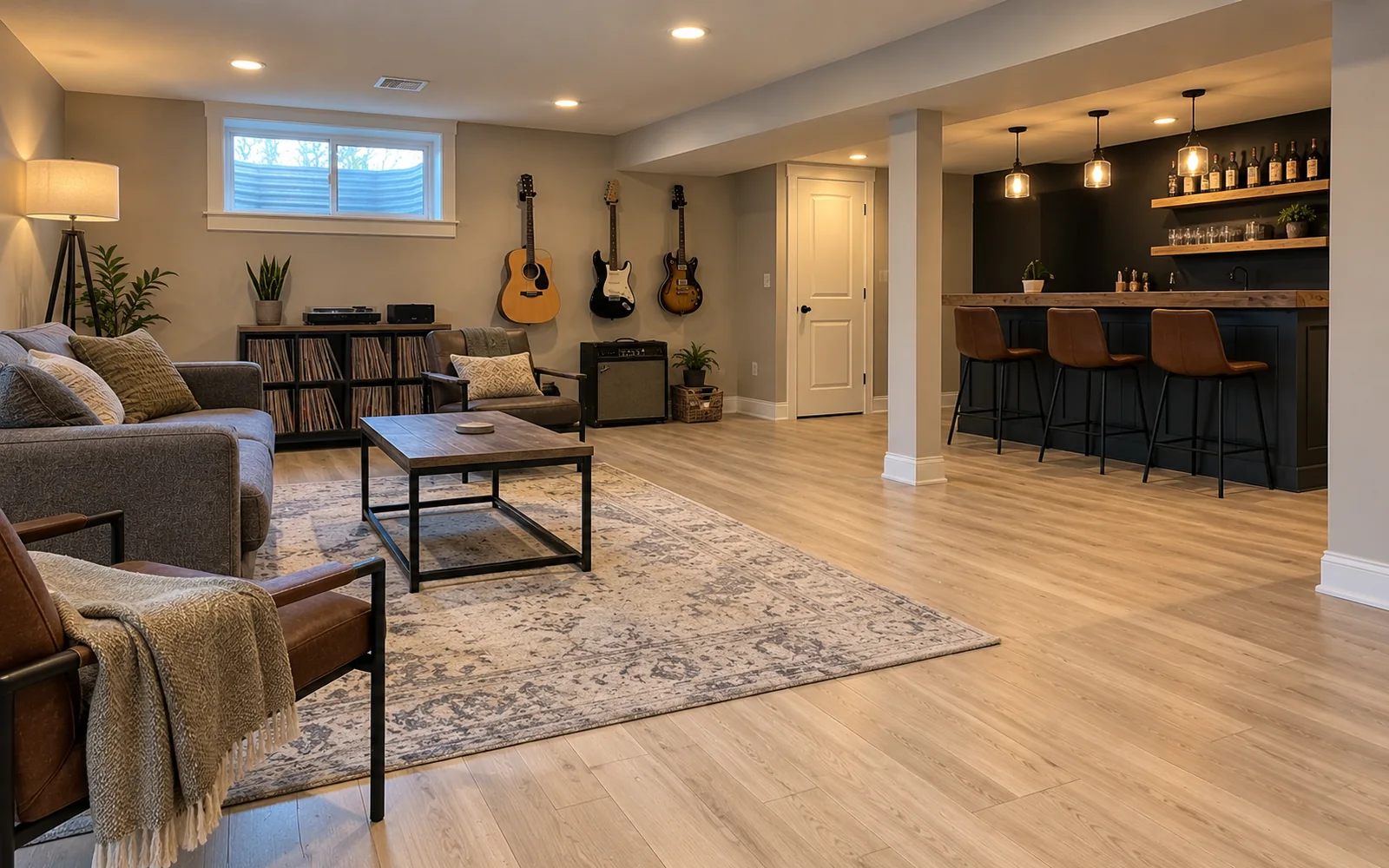
For most Barrie basements, vinyl plank is the safest all-round choice, laminate works well in a dry basement, and epoxy suits utility rooms, workshops and storage areas. What decides which one lasts is not the floor itself but what's under it: how much moisture comes through the concrete and how flat that concrete is.
Basements are the one part of the house where a floor sits directly on a concrete slab that's in contact with the ground. Through Barrie's cold winters, freeze-thaw cycles and humid summers, that slab can stay cool and pick up moisture, and the wrong product can cup, swell or smell musty within a few seasons. So before you pick a floor, it helps to know what your basement is like, what prep it'll need, what it costs and how long the job takes.
Thinking about a basement floor now? Tell Rob about your basement: how you'll use the space and any water history you've noticed. Estimates are free, written and no obligation, and he usually responds within about 24 hours.
Start with moisture, not the flooring sample
First, look honestly at how your basement behaves through the year. Signs worth noting:
- Water stains or efflorescence (white, chalky residue) on the concrete walls or floor
- Damp spots after heavy rain or spring melt
- A musty smell or high humidity in summer
- Condensation on cold pipes, windows or the slab itself
Some moisture through a concrete slab is normal. Active water coming in is a different problem. If water is pooling, seeping through cracks or showing up every spring, that needs to be dealt with first. Common fixes include correcting the grading around the house, extending downspouts away from the foundation, sealing cracks or improving drainage. No floor, however water-resistant, fixes a wet basement. It only hides the problem until it shows up as mould or damage.
Most laminate and vinyl plank today comes with the underlay already attached, which makes the install simpler. Check the manufacturer's install instructions before you buy, since they'll tell you if that product needs anything else underneath in a basement.
Which basement flooring fits which basement
Hunt installs laminate, vinyl, vinyl plank and epoxy. Here's how each one generally fits a basement.
Vinyl plank: the safe default for most basements
Many vinyl plank products are built with a waterproof core, so a spill, a damp spring or a minor plumbing leak is far less likely to ruin the floor. It's comfortable underfoot, looks like wood and handles basement temperature swings. For a finished rec room, guest bedroom, home gym or basement apartment, vinyl plank is usually where most homeowners land.
Laminate: good value in a consistently dry basement
Laminate is hard-wearing and resists scratches well, which makes it a good fit for high-traffic family rooms. Its core is typically made from wood fibre, so standing water is its weakness. In a basement that stays dry year-round, laminate can perform well. If you've had any water history, vinyl plank is usually the lower-risk pick. For a deeper side-by-side, see our guide to vinyl plank vs laminate.
Sheet vinyl: simple and water-resistant
Sheet vinyl has fewer seams for water to get through, which suits laundry areas and basement bathrooms where splashes are routine.
Epoxy: for working spaces
An epoxy coating bonds to the concrete itself, creating a tough, easy-to-clean surface. It's a strong choice for utility rooms, workshops, storage areas and laundry spaces where durability matters more than warmth underfoot. Epoxy depends on sound concrete, so the condition of the slab matters.
What to generally avoid below grade
Solid hardwood and wall-to-wall carpet are widely considered poor choices directly on a basement slab. Hardwood reacts to moisture and humidity changes, and carpet can trap moisture and odours against the concrete.
Not sure which of these suits your space? When Rob comes to look at the basement, he'll talk through the products you're looking at and how you'll use the room before you commit to anything.
Subfloors and levelling: what's really involved
Basement slabs are rarely perfectly flat. Click-together flooring needs a reasonably even surface, otherwise planks can flex, gaps can open and the locking joints can wear.
The good news is that in Rob's experience, subfloor levelling usually isn't needed. When it is, it's done before the flooring goes down and priced once Rob has seen the floor, so you're not paying for a guess.
You may also come across raised subfloor panels or a framed wood subfloor as basement options. These can add warmth and a small air gap between the slab and the finished floor, but they also add cost and height, which matters with low basement ceilings and stairs. If you're weighing one, raise it during the estimate visit so the written estimate reflects exactly what you want.
Finishing the whole basement? Plan the floor last
If your basement is still bare concrete walls, the flooring is the final step of a bigger job. Hunt handles the whole basement: framing, insulation, vapour barrier and drywall, then the floor. Doing the walls first keeps drywall dust and mud off the new floor. Read more in drywalling a basement in Barrie or see our home renovation services.
If plumbing or electrical work is part of the plan, such as a basement bathroom or new lighting, Hunt coordinates licensed plumbers and electricians when needed, so you're not managing separate trades yourself.
Finishing the basement or just replacing the floor? Either way, Rob can scope it in one free, written, no-obligation estimate, from framing and drywall through to the final floor. He usually responds within about 24 hours, and booking early helps get your project on the schedule sooner. Call 705-716-7069 or request your estimate online.
What basement flooring typically costs
For laminate and vinyl plank, here's what it typically costs installed in the Barrie area:
- $2.00 to $5.00 per square foot in Barrie for labour only, for laminate or vinyl plank when you supply the flooring.
- $4.00 to $9.50 per square foot in Barrie with the flooring supplied and installed, depending on the product and how much prep the floor needs.
Your written estimate confirms the final figure. Other items that can affect the total:
- Removing old flooring: demo and disposal are extra where required, and both are itemized on your written estimate.
- Transitions: where the new floor meets carpet or tile, transitions are included in the price. Hunt aims for seamless runs where possible.
- Baseboard and shoe moulding: extra; local installed pricing can vary roughly from $2 to $5 per linear foot depending on profile, material and finishing.
- Subfloor levelling: only when needed, priced after seeing the floor.
Epoxy and sheet vinyl aren't covered by those rates; they're quoted on your written estimate. For a fuller breakdown, see what affects flooring installation cost in Barrie or visit our flooring installation page.
Every estimate is written, so you know what's included and what isn't before you pay a deposit. Payment is 50% up front and the remainder on completion.
How long a basement floor takes
A typical flooring install usually takes about two days. Jobs with a lot of demo take longer, and if the floor is part of a full basement finish, framing and drywall come first. Your estimate will lay out the scope so you can plan around it.
Speed matters when there's a deadline, and Hunt has handled tight timelines before:
"I was in a situation in which I needed quality flooring done quickly as I had a condo listed that needed updating. Rob did a fantastic job of installing the new flooring, and it looked great. A very professional job done with a tight deadline. Highly, highly recommended!" Holly Manning, Facebook recommendation
Questions to ask any basement flooring contractor
Whoever you hire, get clear answers to these before you sign. Here's how Hunt answers them:
- Is the estimate written and itemized? Yes. Demo, disposal, baseboards and any levelling are listed, and transitions are included.
- Are you insured? Hunt carries general liability insurance and WSIB coverage.
- Who will I actually be talking to? Rob, directly, from the first call to the final cleanup. He brings 10 years of industry experience.
- How soon can you start? It depends on the schedule at the time. Booking your estimate early helps get your project in sooner.
- Will you clean up? Every job gets progress updates and a final cleanup.
Hunt works with homeowners, rental and property owners, and approved commercial clients across Barrie and surrounding communities.
Get your basement flooring estimate
Tell Rob what you plan to use the basement for, roughly how big it is and any water history you've noticed. He'll review it, visit if needed and send a free written estimate with no obligation, usually within about 24 hours.
Call 705-716-7069, email quotes@huntcontracting.ca, or request your free estimate.
Common questions
Frequently Asked Questions
What is the best flooring for a basement in Barrie?
For most finished basements, vinyl plank is the safest choice because many products have a waterproof core and handle temperature swings well. Laminate works in basements that stay dry year-round. Epoxy suits utility rooms, workshops and storage areas. Solid hardwood and carpet are generally poor choices directly on a concrete slab.
Can you put laminate flooring in a basement?
Yes, in a basement that stays consistently dry. Laminate's core is typically wood fibre, so standing water is its main weakness. If your basement has any history of leaks or seepage, fix the water source first and consider vinyl plank instead. Always follow the manufacturer's basement installation instructions for the specific product.
How much does basement flooring cost in Barrie?
For laminate and vinyl plank in Barrie, labour-only installation commonly falls around $2.00 to $5.00 per square foot, while supply-and-install pricing can run roughly $4.00 to $9.50 per square foot. Demo, disposal, baseboards and any levelling can move the total. Epoxy is quoted separately. Your written Hunt estimate confirms the exact figure.
Do I need to level my basement floor before installing flooring?
Usually not. In Rob's experience, most floors don't need levelling before laminate or vinyl plank goes down. When a floor is too uneven, levelling is done first so planks don't flex or separate. It's priced after Rob sees the floor, so the cost appears on your written estimate before work begins.
How long does basement flooring installation take?
A typical flooring install usually takes about two days. Jobs with a lot of old flooring to remove take longer. If you're finishing the whole basement, framing, insulation and drywall happen before the floor goes down. Start dates depend on Hunt's schedule, so booking your estimate early helps get your project in sooner.
Planning a flooring project?
Send Rob your address, which rooms, what's on the floor now and a few photos. Free written estimate.
Request a Flooring Estimate